

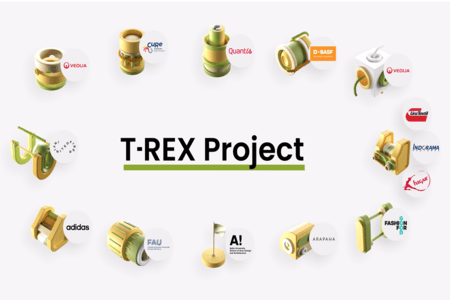
T-REX Project charts a path for scaling textile recycling
YarnsandFibers News Bureau 2025-05-29 16:15:07 – NetherlandsThe European Union’s T-REX (Textile Recycling Excellence) Project has now been successfully completed. The project has resulted in a detailed guide for increasing textile-to-textile recycling in Europe. It also includes sample products made using recycled polyester, polyamide 6, and cellulosic materials, demonstrating that these processes can work effectively within Europe.
This guide is based on thorough research carried out by the project team, which was led by Fashion for Good. The T-REX Project began in June 2022 and brought together 13 important organisations from different parts of the industry. Their aim was to create a clear and united strategy for recycling used household textiles across the EU in a circular way.
To solve the issue of textiles sorting, the industry must invest in automated sorting technologies like near-infrared scanners and systems powered by artificial intelligence. These tools can better identify and sort mixed or layered fabrics. Research and development should also focus on improving how well machines can spot different fabric types and unwanted materials.
Standard mechanical pre-treatment of used textiles, ideally near sorting centres, can improve both quality and efficiency. In addition, chemical treatment should be adapted to match each recycler’s specific needs. Mechanical steps can be added at the sorting stage, while chemical ones can be handled by the recyclers themselves.
To make textile recycling grow in Europe, there must be a combined effort from finance, policy, and industry. These efforts should support demand for recycled materials, reduce overall costs, and attract the funding needed. At the same time, recycling must be part of a larger circular approach that also includes reusing, repairing, and smarter product design.
related news

.jpg)


Market Intelligence
Ask for free sample Report

experience
Customer Base
dedicated team
Countries Served Worldwide
newsletter
Register below to receive our newsletters with latest industry trends and news!