

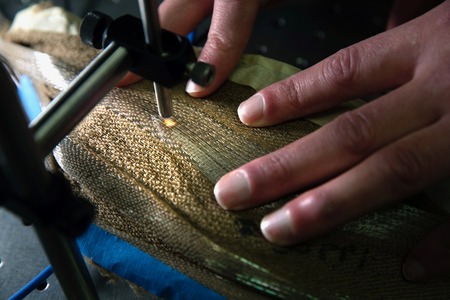
Fibarcode develops fiber-embedded barcodes for textile recycling
YarnsandFibers News Bureau 2025-11-25 14:15:25 – USAA University of Michigan spin-out, Fibarcode, aims to permanently connect textiles with their life-cycle information, from where they were made to how they are disposed of, by embedding barcode-like identifiers directly into fabric fibers. The purpose is to make garments easier to recycle and much harder to counterfeit.
Fibarcode has created a photonic fiber technology that allows unique optical signatures to be built into yarn. These signatures act like barcodes. When scanned with infrared or other types of light, they provide detailed information about the garment, including its origin, production method and material composition.
This system is not a printed label or a stitched tag, but a code woven into the fiber itself, “the thread that is read,” as the company describes it. Unlike traditional tags that can be removed, fade or get damaged, this embedded photonic code stays intact throughout the garment’s entire life.
The company’s innovation is based on research carried out at the University of Michigan and MIT Lincoln Laboratory’s Defense Fabric Discovery Center. It uses advanced photonic design, where micro-layered polymer structures create the optical barcode effect. According to MIT Lincoln Lab, standard spectrometers can read these fiber barcodes, making the system compatible with current industrial equipment.
related news






Market Intelligence
Ask for free sample Report

experience
Customer Base
dedicated team
Countries Served Worldwide
newsletter
Register below to receive our newsletters with latest industry trends and news!